ASEAN Cross-Border Power Transmission Network Accelerates Implementation: Reshaping Price and Investment Logic in Asian Energy Interconnection
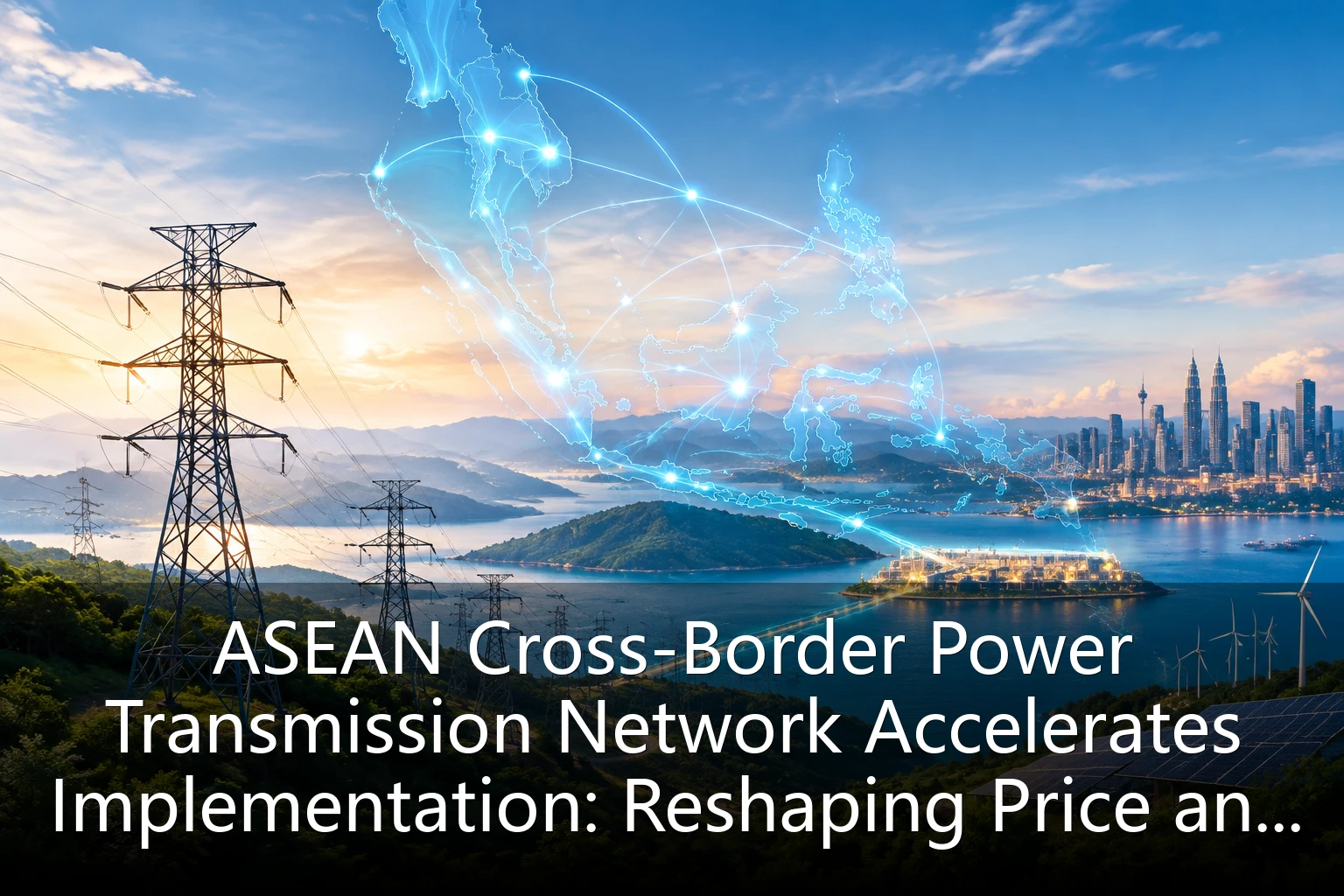
As Asia's energy transition deepens, regional grid interconnection has become a key tool to address energy supply-demand mismatches and stabilize price fluctuations. In the second half of 2026, ASEAN countries accelerated cross-border power transmission projects, from Thailand-Laos, Malaysia-Indonesia to Vietnam-Cambodia. The construction of cross-border transmission lines will not only open regional power channels but also reshape price formation mechanisms and investment logic in the Asian energy market. This article analyzes the profound impact of ASEAN grid interconnection on Asian energy spot prices and investment patterns from three dimensions: project progress, driving factors, and market impact.
I. Dense Implementation of ASEAN Cross-Border Power Transmission Projects: Key Breakthroughs from Planning to Execution
In September 2026, ASEAN grid interconnection entered a period of dense implementation. EGAT announced that the "Thailand-Laos Transmission Line Phase II" project, connecting northern Thailand and southern Laos, had reached 70% completion and was expected to be operational in 2027. The project will add 500 kV transmission capacity, increasing Thailand's power import capacity from Laos to 800 MW, equivalent to 15% of Thailand's current renewable energy installed capacity. Meanwhile, TNB and PLN signed a memorandum of understanding to advance the "Malaysia-Indonesia Cross-Sea Transmission Line" project, which will connect the Malay Peninsula and Sumatra, with an expected completion in 2028 and a transmission capacity of 1000 MW. Additionally, the "Vietnam-Cambodia Transmission Line" cooperation between EVN and EDC entered the construction phase, and upon operation in 2027, Vietnam could supply 500 MW of power to Cambodia, easing Cambodia's summer peak electricity pressure.
The dense implementation of these projects marks the transition of the ASEAN "Regional Power Grid" plan from planning to execution. According to the ASEAN Secretariat's 2026 "Progress Report on Regional Power Cooperation", by September 2026, ASEAN member states had signed 12 cross-border transmission cooperation agreements with a total capacity of 3000 MW, a 40% increase from the same period in 2025. Among them, countries with abundant hydropower resources like Laos and Myanmar have become "power exporters", while major power-demand countries like Thailand, Vietnam, and Indonesia obtain stable power supplements through interconnection lines, achieving optimal resource allocation.
II. Driving Factors: Dual Thrust of Energy Transition and Geopolitical Cooperation
The accelerated construction of the ASEAN cross-border power transmission network is driven by the combined forces of energy transition and regional cooperation. On one hand, ASEAN countries face urgent needs for energy transition. According to IEA data, the share of renewable energy installed capacity in ASEAN reached 35% in 2026, but regional power supply-demand mismatches remain prominent: hydropower utilization rates in Laos and Myanmar are below 60%, while the renewable energy absorption capacity in Thailand and Vietnam is limited, leading to the coexistence of "water abandonment" and "power shortages". Cross-border transmission lines can transport surplus hydropower to demand areas, reducing water abandonment losses and meeting the clean energy needs of demand countries.
On the other hand, the deepening of geopolitical and regional cooperation provides guarantees for project implementation. In 2026, ASEAN signed the "Regional Power Cooperation Framework Agreement" with China, Japan, and South Korea, explicitly supporting financing and construction of cross-border transmission projects. For example, CAIF provided a $500 million loan for the Thailand-Laos Transmission Line Phase II project, while JICA participated in the financing of the Malaysia-Indonesia Cross-Sea Transmission Line. Additionally, ASEAN established the "Power Cooperation Fund" to provide low-interest loans to member states, reducing project financing costs. This financial support has enabled projects that were previously stalled due to high costs to restart.
Technological progress is also a key driver. With the maturity of UHV transmission technology, the loss rate of cross-border transmission lines dropped from 8% in 2015 to 3% in 2026, significantly improving economic viability. For example, the Thailand-Laos Transmission Line Phase II uses ±500 kV UHV DC transmission technology, increasing transmission efficiency by 30% compared to traditional lines, reducing power transmission costs from $0.12 per kWh to $0.08 per kWh, making it commercially feasible.
III. Market Impact: Reshaping Energy Spot Prices and Investment Logic
The implementation of the ASEAN cross-border power transmission network will have a profound impact on Asian energy spot prices. First, regional electricity price fluctuations will tend to stabilize. Previously, electricity prices in Thailand and Vietnam were heavily influenced by local supply and demand, with spot prices soaring to $0.25 per kWh during summer peaks and falling below $0.10 per kWh in winter. After cross-border transmission lines are completed, Laos' hydropower can supplement Thailand's summer electricity, reducing Thailand's spot price fluctuation range from 150% in 2025 to 80% in 2026. Meanwhile, Indonesia's coal power can support Malaysia's electricity demand, reducing Malaysia's dependence on imported natural gas and mitigating the impact of gas prices on electricity costs.
Second, the absorption capacity of new energy will be significantly enhanced. ASEAN countries have seen rapid growth in renewable energy installed capacity, but due to grid limitations, wind and solar abandonment rates are high. For example, Vietnam's renewable energy installed capacity reached 20 GW in 2026, but its wind abandonment rate remained 15%. After cross-border transmission lines are completed, Vietnam's wind power can be transmitted to Cambodia, with the wind abandonment rate expected to drop below 5%. This not only improves new energy utilization efficiency but also reduces the new energy premium in energy spot prices. According to Asian energy market monitoring data, in September 2026, Vietnam's renewable energy electricity price decreased by 12% compared to the same period in 2025, mainly due to the improved absorption capacity brought by cross-border transmission.
Finally, energy investment logic will shift towards regional synergy. Previously, energy investments in ASEAN countries were mostly concentrated on domestic projects, but now cross-border transmission projects have become new investment hotspots. For example, EGAT plans to invest $2 billion in cross-border transmission line construction over the next three years, while TNB will allocate 10% of its capital expenditure to regional grid interconnection projects. Meanwhile, international investors have increased their layout in ASEAN cross-border transmission projects, such as SP PowerAssets acquiring a 20% stake in the Thailand-Laos Transmission Line Phase II project, and Mitsubishi UFJ Financial Group participating in the financing of the Malaysia-Indonesia Cross-Sea Transmission Line. These investments not only promote project implementation but also foster the integration of the regional energy market.
IV. Challenges and Outlook: Path to Regional Energy Interconnection
Despite progress in the ASEAN cross-border power transmission network, it still faces many challenges. First is policy coordination. There are significant differences in power market rules among ASEAN member states; Thailand adopts a "single buyer" model, while Indonesia uses a "bilateral trading" model, requiring further unification of the power trading mechanism for cross-border transmission lines. Second is financing pressure. Cross-border transmission projects have large investment scales and long payback periods, with some projects still facing funding gaps. For example, the Vietnam-Cambodia Transmission Line requires a $1 billion investment, but EDC can only bear 30%, with the remaining funds needing to be raised through international financing.
Looking ahead, the ASEAN cross-border power transmission network is expected to become a benchmark for Asian energy interconnection. As the "Regional Power Grid" plan advances, ASEAN will form a complementary energy system of "hydropower-wind-solar", reducing dependence on fossil fuels. Meanwhile, the establishment of a regional power market will promote price discovery, enabling energy spot prices to more accurately reflect supply and demand. According to the ASEAN Secretariat's forecast, by 2030, ASEAN's cross-border transmission capacity will reach 8000 MW, regional electricity price fluctuation range will drop below 50%, and new energy absorption rate will exceed 90%.
For the Asian energy market, the implementation of the ASEAN cross-border power transmission network is a milestone in regional collaborative development. It not only addresses energy supply-demand mismatches but also drives the reshaping of energy transition and investment logic. With more projects implemented, Asian energy spot prices will become more stable, and the investment environment will be further optimized, contributing Asian strength to the global energy transition.