Ripple Effects of Middle East Turmoil: Why Will Singapore's Third-Quarter Electricity Prices Still Rise Significantly?
Keywords: Singapore electricity price, regulated electricity price, Strait of Hormuz, natural gas price, U-Save rebate, fixed-price contract, Energy Market Authority
Introduction
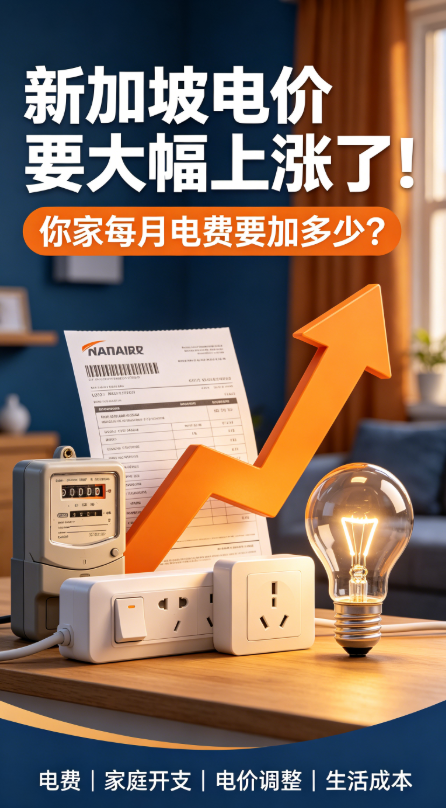
A geopolitical conflict in the Middle East may eventually manifest directly in Singaporean households' electricity bills. The Energy Market Authority (EMA) recently confirmed that despite the U.S. and Iran signing an agreement on June 18 and Strait of Hormuz shipping gradually resuming, Singapore's regulated electricity prices for July to September this year are still expected to show a 'significant' increase. For ordinary households, this is not distant international news but a tangible burden visible in the next bill.
Currently, the regulated electricity tariff (including GST) for Singaporean homes is 29.72 cents per kWh. Many analysts expect the third-quarter tariff increase to range from mid-single digits to 20% to 30%. For example, monthly electricity bills for a four-room HDB flat may increase by about S$30. While this appears to be a quarterly adjustment, it reflects the vulnerability of Singapore's energy structure, the volatility of global fuel markets, and the choices households face in an uncertain environment.
1. Electricity Price Increase Does Not 'Immediately Rebound After Ceasefire'
Many may wonder: since the U.S. and Iran have reached an agreement, why are electricity prices still rising? The answer lies in the 'time lag' of the tariff adjustment mechanism.
Singapore's regulated electricity tariff is adjusted quarterly, and the pricing basis is not the current fuel price but the average fuel cost of the first two and a half months of the previous quarter. In other words, the tariffs for July to September mainly reflect the natural gas price levels from April to mid-June this year.
The problem is precisely that during this period, the Middle East situation remained tense, with the conflict escalating to the point of affecting Gulf energy infrastructure. As one of the world's most critical energy channels, the Strait of Hormuz handles about one-fifth of global oil and gas transportation. Once the channel is disrupted, the market quickly expects supply contraction, causing natural gas prices to rise sharply. EMA also clearly stated that it was the Middle East conflict disrupting global fuel supply chains, leading to a significant increase in natural gas prices since late February, which drove the next quarter's regulated electricity tariff higher.
This means that even if geopolitical risks have eased, electricity price changes will not 'immediately reverse.' Fuel costs must first fall in the wholesale market, then gradually transmit through contracts, procurement, and pricing mechanisms before households see changes in their bills. Some analysts believe that consumers may not feel the tariff decline until the fourth quarter at the earliest.
2. Why Is Singapore So Sensitive to International Energy Shocks?
Singapore's extreme sensitivity to international fuel price fluctuations stems from its energy structure's high dependence on imports. As a city-state with limited resources, Singapore can hardly rely on localized energy supply to hedge against global market risks. According to official data, imported natural gas accounts for about 95% of Singapore's electricity generation, meaning electricity prices are highly tied to natural gas prices.
In terms of import sources, in 2025, 43% of Singapore's natural gas imports came from pipeline gas from Malaysia and Indonesia, and 57% came from LNG including Middle Eastern countries. While this structure offers some supply diversification, it also exposes Singapore to risks from international transport routes, regional situations, and global spot market price fluctuations. Once a link in the international energy chain becomes unstable, the impact quickly transmits to local power generation costs.
EMA's explanation essentially highlights a fundamental reality of Singapore's energy system: for a small open economy, energy security is not just about 'having electricity' but also about 'whether electricity prices are affordable.' Therefore, international conflicts, changes in shipping routes, and fluctuations in global natural gas prices ultimately compress into residents' monthly fixed expenses.
3. Household Electricity Purchase Preferences Are Changing; Fixed-Price Contracts Attract Attention
Facing price increase expectations, Singaporean households' electricity purchase behavior is also adjusting. EMA data shows that between February 1 and June 1, 2026, the proportion of households choosing fixed-price electricity retail plans rose from 36.6% to 37.1%, while those buying from SP Group at the regulated tariff fell from 63.4% to 62.8%.
This change indicates that more households are seeking 'certainty.' Against the backdrop of energy prices constantly affected by international situations, the appeal of fixed-price contracts is not surprising. They lock in unit prices for a certain period, avoiding the impact of sharp short-term tariff hikes on household budgets, making them particularly suitable for consumers who are sensitive to monthly expenses and want budget control.
However, fixed price does not mean absolute savings. Its essence is to trade stability for price volatility, making it a double-edged sword: when market prices rise, fixed-price contracts protect users; but if geopolitical tensions ease and gas prices fall, contracted users cannot simultaneously enjoy the dividend of price reduction. Therefore, whether to switch to a fixed-price plan depends not only on current increases but also on comprehensive evaluation of household electricity usage, contract term, early termination clauses, and judgment of future market trends.
EMA also advises consumers to fully understand different electricity purchase options and use its price comparison website to make choices. For ordinary households, electricity consumption should not be a matter of 'passively accepting bills' but should gradually shift toward more strategic active management.
4. Government Subsidies Will Buffer Some Pressure, But Cannot Replace Long-Term Planning
It is worth noting that the government is also using fiscal tools to cushion the impact of rising utility costs. According to arrangements, in July this year, eligible HDB households will receive the second round of U-Save utility rebates. Depending on the flat type, each household can receive a rebate ranging from S$110 to S$190, which will be directly deposited into their SP Services accounts to offset utility expenses.
Additionally, the additional U-Save rebate announced in the 2026 Budget will be disbursed in April and July, with eligible HDB households receiving up to S$570 in total subsidies for the year. For low-and middle-income families, such subsidies have practical significance during electricity price upcycles, effectively relieving bill pressure.
However, it must also be noted that subsidies serve more as a 'buffer' than a 'cancellation.' If international energy prices remain high or geopolitical disturbances recur, household expenses will still face sustained pressure. Therefore, subsidies can address short-term issues but cannot substitute for household-level energy budget management and long-term coping strategies.
Conclusion
Overall, the third-quarter electricity price increase in Singapore is almost certain, with only the magnitude of the increase remaining uncertain. Behind it is not a simple local policy adjustment but the combined result of global energy markets, geopolitical risks, and Singapore's own energy dependence structure. Every fluctuation in the Middle East, through the 'energy lifeline' of the Strait of Hormuz, can ultimately be transmitted to the electricity bills of Singaporean households.
For consumers, the most important thing now is not passive waiting but active comparison and reasonable choice: if stability is valued, consider a fixed-price plan; if you judge that the market will fall, continuing to use the regulated tariff may offer more flexibility; also, don't overlook the upcoming U-Save rebates from the government to minimize expenditure pressure.
In an era of normalized energy price fluctuations, electricity bills are no longer just a simple public service expense but a real test of risk management and household financial planning. Doing homework in advance and making rational decisions are key to coping with the next round of price hikes.