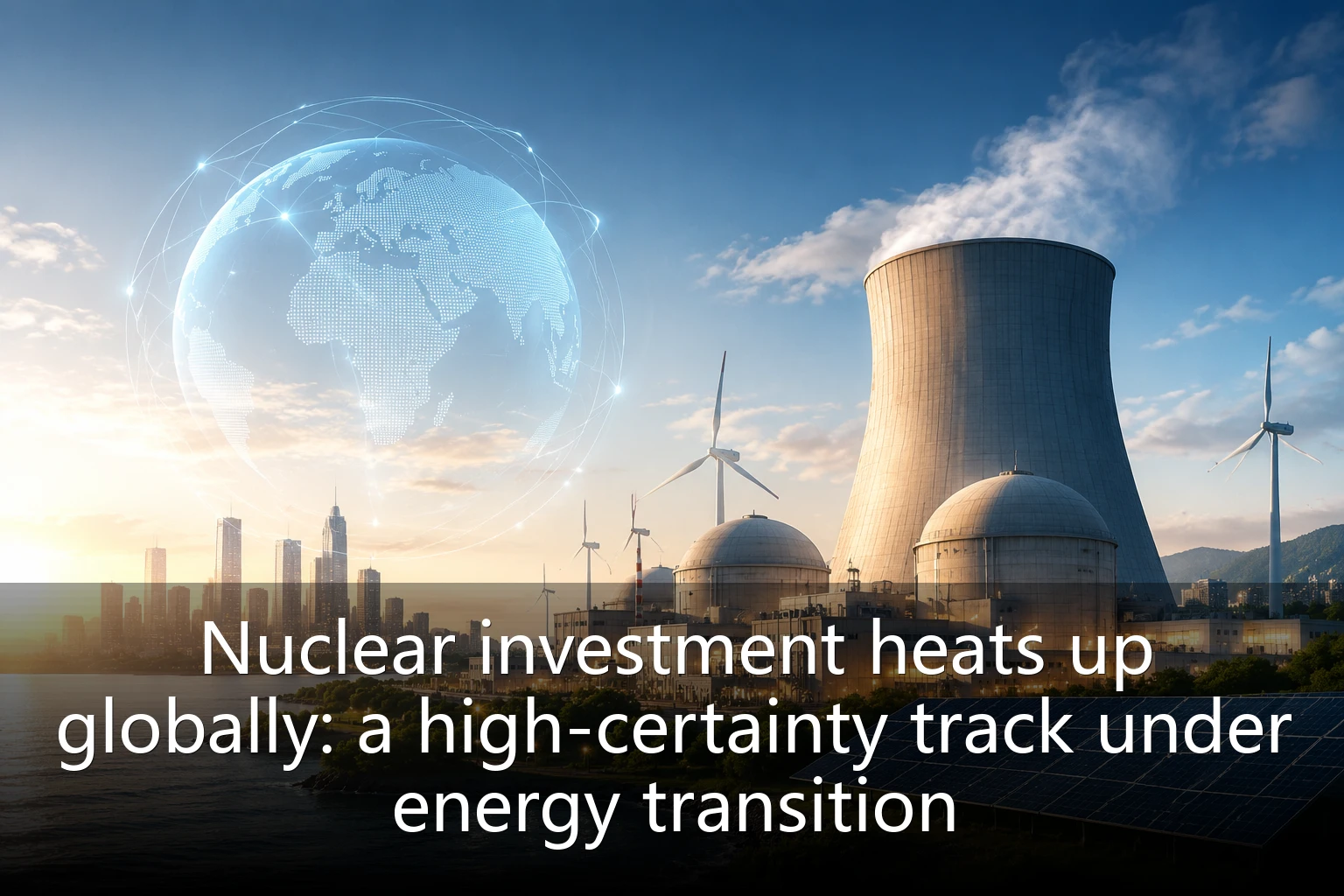
As the global energy transition accelerates, nuclear power, as an efficient and clean baseload energy, is regaining capital market favor. On July 30, the International Atomic Energy Agency (IAEA) released the '2026 World Nuclear Power Development Status and Outlook' report, showing that global nuclear investment has grown for three consecutive years, with cumulative investment in the first half of 2026 rising sharply year-on-year. Global nuclear installed capacity is expected to exceed 450 GW by 2030, a record high. The report has drawn strong market attention to the nuclear sector and once again proves the core logic of 'why invest in energy' - under the parallel context of low-carbon transition and energy security, nuclear power is becoming a premium track combining stable returns and long-term potential.
Global nuclear investment rebounds, Asia becomes main engine
The report says that as of the end of June 2026, 68 nuclear units are under construction globally, more than half of them in Asia. Countries such as China, India and South Korea are actively expanding nuclear power to reduce dependence on fossil fuels. China has already approved multiple Hualong One units and is expected to account for over 40% of global newly added nuclear capacity in the next five years. Besides China, Japan is restarting some idle nuclear plants and plans to develop new-generation light water reactors. South Korea is upgrading its domestic supply chain by exporting nuclear technology.
In Europe, Britain is advancing the Sizewell C nuclear power station, and France has announced a restart of its nuclear construction program, planning to build at least 6 EPR2 units by 2035. These moves show that nuclear power has shifted from ebb to revival, becoming an important lever for countries to achieve carbon neutrality targets.
Why invest in nuclear? Three core logic pillars
- Steady power demand and stable returns: Nuclear power has high utilization hours and stable output, serving as a rare 'all-weather' clean power source in the grid. When wind and solar output is strong, nuclear can carry baseload; when renewables are weak, nuclear properly fills the gap. This gives nuclear assets infrastructure-like attributes and sustainable cash flows for investors. Some power companies have spun off nuclear assets for listing, attracting long-term capital.
- Continuous policy dividends: Many countries have placed nuclear power in green taxonomies, allowing it to enjoy green credit and investment subsidies. In H1 2026, the EU formally included nuclear lifetime extension projects in its sustainable finance framework, and the US Department of Energy announced dedicated support for small modular reactors (SMRs). These policies have triggered a new capital expenditure cycle across the industrial chain, including uranium mining, nuclear fuel processing, and equipment manufacturing.
- Technology iteration lowers costs: Safety and economy were once pain points of nuclear, but a new generation of modular small reactors (SMRs) is expected to resolve this contradiction. SMRs have short construction periods, small investment scale, and strong replicability, and can be applied on offshore platforms and remote mining areas. Westinghouse, NuScale, Rolls-Royce and others launched multiple demonstration projects in 2026, and by 2030 SMR electricity costs are expected to be 30% lower than conventional nuclear, opening broader space for nuclear investment.
Investment risks and sober thinking
Of course, nuclear investment is not risk-free. Construction delays and accident risks remain lingering shadows; in addition, radioactive waste disposal and public acceptance affect project implementation efficiency. Investors need to screen quality targets with real technical strength, safety records and policy endorsement, and avoid blindly following trends.
Currently, nuclear fuel price volatility is another major variable. Affected by multiple factors such as Kazakhstan's output increase and Russian export restrictions, uranium prices spiked to a near-decade high in Q1 2026 and then fluctuated, but a long-term supply-demand gap remains, leaving miners and traders optimistic.
Industrial linkage: from electricity prices to energy markets
Large-scale nuclear investment will also profoundly affect electricity market pricing. In some spot markets, nuclear, as a power source with extremely low marginal cost, helps lower clearing prices and improve grid efficiency. Meanwhile, coordinated development of nuclear with wind and solar is emerging; for example, combining nuclear plants with pumped-storage hydro to achieve flexible peak shaving via 'large nuclear + large storage'. Such multi-energy complementary layouts offer energy investors more structural opportunities.
In Asian energy markets, companies such as Japan's TEPCO and South Korea's Hydro & Nuclear Power have begun deploying nuclear hydrogen production, exploring a 'nuclear-hydrogen' chain and extending energy investment value. Energy price trends also show nuclear serves as a ballast for stabilizing regional energy prices, reducing reliance on LNG and coal.
Outlook: nuclear will become a 'core asset' in energy investment portfolios
Overall, nuclear power has high certainty, long cycles, and low carbon emissions, closely matching ESG investment principles. Under the grand narrative of the energy revolution, valuation systems for the nuclear sector are being reshaped. Several international investment banks have recently upgraded ratings for nuclear equipment makers and uranium miners, believing their growth is no less than midstream new energy links.
From the perspective of 'why invest in energy', nuclear power unquestionably offers a compelling answer: it is not aggressive theme speculation, but a long-term allocation based on real demand. For institutional investors seeking stable returns and industrial capital concerned about energy security, nuclear power deserves attention.
In short, the strong return of global nuclear power in 2026 is a vivid footnote to the deep evolution of energy markets. As more countries make nuclear a strategic choice, this once-controversial energy source is quietly becoming one of the most stable investment anchors.