
Japan and South Korea Stock Markets Open Higher Together: New Signal for Regional Markets Amid Rising Risk Appetite
Keywords: Japan Stock Market, South Korea Stock Market, Nikkei, KOSPI, Asian Market, Risk Appetite, Global Liquidity, Export Expectations, Tech Stocks, Macroeconomy
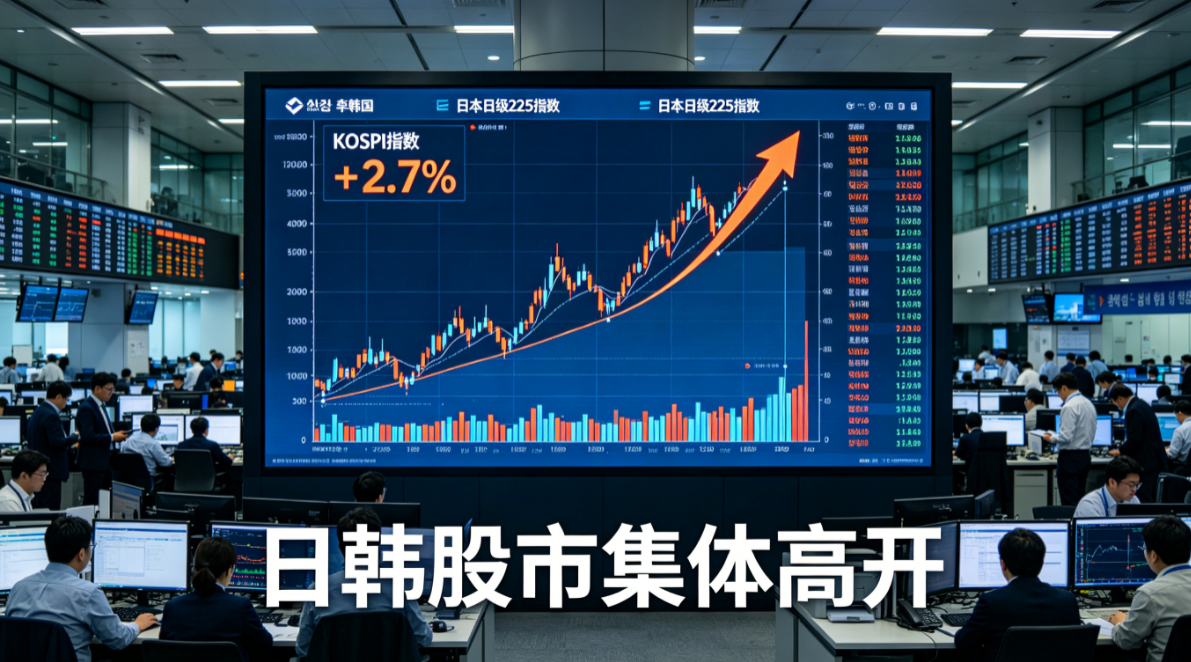
Recently, major Asian stock markets opened strongly, with Japan's Nikkei rising 1.4% to 70114.09 and South Korea's KOSPI rising 2.7% to 8703.42 at opening. The simultaneous rise of the two markets not only reflects a staged improvement in investor sentiment but also indicates changes in global capital's willingness to allocate to Asian assets. For investors who have long focused on East Asian economies and capital markets, this phenomenon is both a short-term trading signal and an important window to observe macro environment, industry trends, and policy expectations.
I. Market Logic Behind Broad-Based Opening Gains
From a market mechanism perspective, a significant rise in stock indices at the opening is often not accidental, but the combined result of overseas markets from the previous session, macro data, policy expectations, and capital flows. The simultaneous upward movement of Japanese and South Korean stock markets indicates that market participants' perceptions of Asian economic growth prospects, corporate profit improvement, and global interest rate environment are undergoing positive changes.
First, overall risk asset preferences are recovering. Over the past period, global markets have been affected by inflation trends, major economy monetary policy adjustments, and geopolitical uncertainty, causing investors to switch between defensive assets and high-liquidity assets. Recently, as external market volatility has eased, some funds have flowed back into Asian markets with relatively attractive valuations and industrial growth stories. Japan and South Korea both fit this description: the former has mature manufacturing, automation, and high-end equipment industrial chains, while the latter is globally competitive in semiconductors, display panels, batteries, and export manufacturing.
Second, export-oriented economies are more likely to see valuation rebounds under expectations of improving external demand. Japan and South Korea are highly dependent on the global trading system, with deep participation in industries such as electronics, automobiles, machinery, and chemicals. When the market expects global terminal demand to improve, the tech cycle to pick up, or inventory destocking to near an end, related sectors will first reflect at the index level.
II. Japan Stock Market Rise: Resonance of Manufacturing, Tech, and Governance Reform
Japan's stock market opening higher continues market attention to its structural improvements. In recent years, Japanese capital markets have been favored by overseas investors, an important reason being the gradual progress of corporate governance reform, with listed companies paying more attention to shareholder returns, capital efficiency, and valuation management. Compared to past conservative balance sheet strategies, more Japanese companies are enhancing market appeal through buybacks, dividends, and spinning off non-core assets.
More importantly, Japan has long-term advantages in high-end manufacturing, industrial automation, precision equipment, and materials. Whether it's global semiconductor industry expansion or new energy vehicles, robotics, and digital upgrading, Japanese companies may benefit from the supply chain. Therefore, when global tech investment themes revive, the resilience of Japan's market should not be underestimated.
From an industry perspective, the Nikkei's rise is not just driven by a few heavyweight stocks, but reflects the market's improved expectations for the overall profit environment. If the yen remains relatively moderate and overseas demand maintains resilience, the profit margins of export companies are usually more stable. Meanwhile, signs of domestic wage growth and consumption confidence improvement could also support the domestic-demand sector. For an economy long in a low-inflation environment, demand recovery and price normalization are prerequisites for asset pricing improvement.
Of course, the rise of Japan's stock market should also be observed within the framework of valuation matching fundamentals. If the rise is mainly sentiment-driven without simultaneous repair in corporate profits, there may still be pullback pressure later. Investors should focus on corporate earnings reports, capital expenditure plans, and whether policy orientation can continue to support the rally.
III. South Korea KOSPI Surge: Semiconductor Cycle and Export Expectations in Focus
Compared to Japan, South Korea's stock market is more sensitive to the global semiconductor cycle and tech demand. The KOSPI's 2.7% opening gain shows that market confidence in South Korea's core industrial chain has significantly strengthened. In South Korea's economic structure, export industries such as semiconductors, electronic equipment, automobiles, and batteries occupy a very important position. Therefore, when global tech sentiment shows marginal improvement, South Korea's market tends to react first.
The close relationship between South Korea's large tech and manufacturing companies' stock prices and external demand means that if the market expects a rebound in memory chip prices, growth in AI server demand, or start of consumer electronics restocking, the resilience of South Korea's market becomes relatively prominent. The rapid rise in KOSPI during the session usually means that investors are pre-trading profit recovery in the upcoming quarters, rather than just reflecting the day's sentiment.
Notably, South Korea's market is also significantly affected by the local currency exchange rate, US tech stock trends, and global capital flows. If the dollar is stable and foreign capital returns to emerging Asian assets, South Korea's market often gains additional support. Conversely, if the external environment suddenly tightens, volatility in South Korea's stock market will also increase significantly. Therefore, while the opening gain is impressive, for the future, sustainability depends on whether export data, corporate orders, and the global tech cycle can continue to improve.
IV. Asian Market Linkage: Capital Reassessing Regional Assets
The synchronous surge of Japanese and South Korean stock markets indicates that Asian markets are not operating in isolation but are driven by the same set of macro factors. The current repricing of Asian assets by global capital markets may come from several levels:
First, changes in global interest rate expectations affect capital allocation. If the major economies' rate hike cycle is near its end, or the market begins to price in rate cuts, growth and export assets usually regain valuation premiums. Japan and South Korea are both sensitive to global liquidity, so they react faster when funding conditions improve.
Second, the recovery of the tech industry chain is becoming a core theme in regional markets. Whether it's computing power demand from AI or global electronic product upgrades, it can drive semiconductors, equipment, and materials sectors to revive. Japanese and South Korean companies occupy key positions in this chain, naturally attracting international capital attention.
Third, the regional policy environment is relatively stable. Compared to some emerging markets, Japan and South Korea have more mature financial systems, higher information transparency, and stronger institutional predictability, making them more attractive for risk-on capital inflows during periods of uncertainty.
V. Three Key Variables for Investors to Watch
Although the opening rise sends a positive signal, the market's subsequent trend still depends on several key variables.
1. Exchange Rate Trends
Fluctuations in the yen and won directly affect export company profits. If the local currency appreciates too quickly, overseas income converted back to local currency may come under pressure; if the exchange rate remains relatively balanced, it is conducive to the continuation of the stock market uptrend.
2. Global Demand Recovery Pace
The Japanese and South Korean economies are highly dependent on external markets, so European and US demand, global manufacturing sentiment, and tech consumption cycles will determine whether corporate profits can be upgraded further. A single day's rise does not equal trend confirmation; further observation of orders, inventory, and profit data is needed.
3. Policy and Liquidity Environment
Japan's corporate governance reform, capital market incentive policies, and South Korea's policy efforts in industrial upgrading and export support will all affect medium- to long-term valuations. If policies continue to improve, the market may form a more stable upward channel; if external tightening or domestic policy disappoints, the rally may cool in stages.
VI. From Trading Signal to Trend Judgment: Short-Term Optimism, Long-Term Fundamentals Still Matter
From the market performance, the synchronous rise of Japanese and South Korean stock markets at the opening reflects investor optimism toward core Asian assets, especially positive expectations for exports, tech, and manufacturing sectors. Such moves usually mean the market is pre-pricing 'recovery' rather than 'recession,' and trying to find growth themes amid uncertainty.
However, what truly determines stock market trends is not a single opening, but whether profit, policy, and capital form a positive cycle. If corporate profits can continue to improve, the policy environment remains friendly, and global liquidity is not significantly tightened, then the upside space for Japanese and South Korean stock markets could still continue. Conversely, if the market rise is just a concentrated reaction to short-term positive factors, subsequent volatility will increase accordingly.
For investors, a more robust strategy is not to chase single-day gains, but to make dynamic allocations around industry trends, valuation levels, and macro rhythms. For Japan, focus on beneficiaries of corporate governance reform, high-end manufacturing, and domestic-demand repair; for South Korea, focus on key companies in semiconductors, display panels, batteries, and export chains. Only by grasping fundamental logic can one truly understand the long-term meaning behind the opening rise.
Conclusion
Japan's Nikkei and South Korea's KOSPI rising together at the opening shows that Asian markets are at a confluence of improved risk appetite and industry expectation improvement. Japan's stock market benefits from corporate governance optimization, manufacturing advantages, and domestic-demand recovery expectations; South Korea's market reflects more of the semiconductor cycle warming, export outlook improvement, and strong resilience of the tech sector. The tandem rise of the two markets is not only a positive surface reaction but also an important signal of global capital re-examining East Asian assets.
In the future, whether Japanese and South Korean stock markets can maintain their strength still depends on global demand, exchange rate changes, policy support, and actual corporate profit performance. For the market, what is truly worth noting is not the number of a single day's high opening, but whether it implies a more sustainable regional recovery cycle is unfolding.