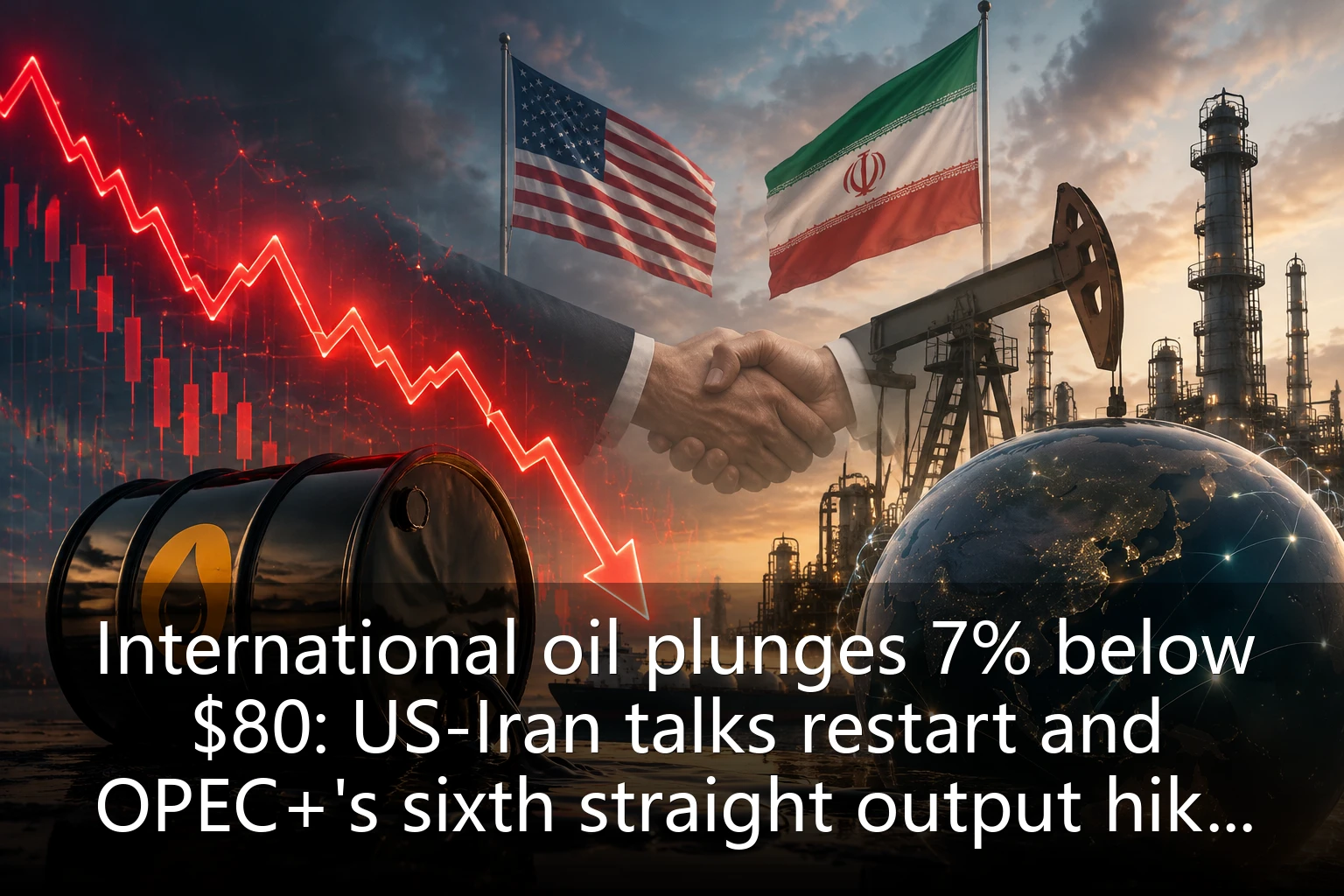
During the first trading week of August 2026, a dramatic turn unfolded in global oil markets. A month earlier, shipping disruptions in the Strait of Hormuz and escalating geopolitical conflict had pushed Brent crude up nearly 24% in a single month, approaching the $90 mark. But in August, with the US cancelling its planned military strike against Iran, both sides returning to negotiations, and OPEC+ raising output for a sixth consecutive month, international oil prices reversed course. Brent futures at one point tumbled more than 7%, breaching both $80 and $75; WTI fell to as low as $74.78 per barrel. Within days, the earlier geopolitical premium was almost completely erased, opening a re-pricing window for Asian energy markets.
U-Turn: From Airstrike Threats to the Negotiating Table
The trigger for this oil crash was a sharp U-turn in the Middle East. On August 1, Washington was still vowing to unleash the "most ferocious bombing" on Iran. Just a day later, the White House announced it was cancelling the strike plan. President Trump publicly said a deal had been reached around the Strait of Hormuz and that an agreement on denuclearization would follow, with US-Iran talks set to resume on August 3. Meanwhile, Treasury Secretary Bessent signaled to media that Washington was in contact with Tehran, and an agreement to reopen the strait could be reached "as soon as this week, or even today or tomorrow," restoring freedom of navigation.
As soon as the news broke, market risk appetite quickly reversed. The war premium that had underpinned high oil prices began to unwind faster. During US trading hours on August 2, NYMEX light crude futures for September delivery fell to as low as $74.78/barrel, down nearly 7% on the day. London Brent futures for October delivery hit a low of $81.55/barrel, a drop of 7.26%. On August 5, the Brent October contract settled at $79.36/barrel, officially below $80, while the WTI September contract settled at $75.77/barrel, down 5.7%. On the Shanghai International Energy Exchange, the main SC crude contract also closed near 510.5 yuan/barrel in night trading, tracking overseas weakness.
The situation, however, is far from settled. Iranian Foreign Ministry spokesman Baghaei reiterated that conditions in the Strait of Hormuz would not return to their pre-conflict state and that the strait's future management should be led by Iran. Tehran has repeatedly denied direct talks with the US, insisting the only ongoing consultations are contacts with Oman over transit arrangements. Shipping analysts remain cautious about whether oil flows can be restored as quickly as Washington suggests. This means there is still a huge uncertainty gap between a deal being "in sight" and actually being "landed."
OPEC+'s Sixth Straight Hike: Voluntary Cuts Head Toward Zero
Alongside the easing of geopolitical sentiment, supply has continued to loosen. On August 2, seven major OPEC+ producers led by Saudi Arabia and Russia held an online meeting and approved another increase of 188,000 barrels per day in their combined production target for September. That marks the sixth consecutive monthly increase in output quotas since OPEC+ began ramping up in April. September's hike will fully offset the impact of the extra voluntary cuts of 1.65 million bpd originally agreed in 2023. The UAE, which had joined that round of quota adjustments, left OPEC in May this year, narrowing the scope of the seven-country reduction alliance.
Notably, another layer of cuts applicable to most OPEC+ members — collective reductions of about 2 million bpd dating back to 2022 — will remain in place until the end of this year. In other words, OPEC+ has chosen a gradual path between "restoring supply" and "maintaining market stability": it sends a signal of returning supply through consecutive small increases while retaining a buffer for contingencies. Rystad Energy analyst Jorge Leon noted that after completing the supply restoration, OPEC+ has little incentive to rush further supply adjustments; the baseline forecast is a pause in output increases in Q4 while preparing for 2027 quota negotiations.
Deeper Meaning of the Output Hike: Preparing for a Post-Conflict Era
In the short term, shipping through the Strait of Hormuz remains constrained, making the increase largely symbolic. But if a US-Iran deal is concluded and Persian Gulf oil flows resume, major producers like Saudi Arabia are fully capable of unlocking more output to help replenish low global inventories. The 67th Joint Ministerial Monitoring Committee meeting also stressed the importance of keeping international sea lanes open to ensure stable energy supplies and expressed concern over attacks on energy infrastructure. The market viewed this as a clear endorsement of "supply restoration" by the producer alliance. The next monitoring meeting is scheduled for October 4, 2026, when the global supply-demand picture will become clearer.
Tale of Two Extremes: Oil Prices Plunge While Energy Giants' Profits Soar
In sharp contrast to the short-term price decline, energy majors delivered "epic" second-quarter results. Fueled by higher international energy prices from the continued blockade of the Strait of Hormuz, ExxonMobil posted second-quarter profit of $14.5 billion, the highest since the 2022 energy crisis. Chevron earned $12.1 billion for the quarter, nearly five times the prior-year level, with record crude and natural gas production and refinery throughput.
After the strong earnings, both giants increased shareholder returns. ExxonMobil and Chevron spent $9.4 billion and $6.6 billion respectively in Q2 on dividends and share buybacks. ExxonMobil also cut net debt by $7 billion with quarterly cash flow and announced deployment of its fifth large floating production, storage and offloading (FPSO) vessel, with a capacity of 250,000 barrels per day, offshore Guyana, expected to start up in Q4.
ExxonMobil CFO Neil Hansen's comments, however, are worth noting: the core problem is not crude itself, whose price remains within historical ranges, but refined products such as gasoline and diesel. Global refining capacity shrinkage has directly pushed up refined product prices. That means even if the geopolitical premium in crude fades, cost pressure on downstream refined fuels and petrochemical feedstocks may not ease in tandem — a structural contradiction that needs particular attention in highly import-dependent Asian economies.
Asian Perspective: Weak Demand and Import Structure Reshaping
From an Asian perspective, the transmission of this price decline is not a "universal benefit." On one hand, China has ample domestic inventories and continues to draw them down rather than buy. Although crude below $80 lowers import costs, it gives limited support to already weak purchasing demand. On the other hand, incremental demand from the Middle East's summer power-generation oil peak, conservatively estimated at about 500,000 bpd in Q3, provides temporary support. Once geopolitical factors retreat, weak demand combined with OPEC+'s consecutive output hikes will jointly suppress medium-term prices.
What deserves attention is the subtle shift in the price structure. Earlier, driven by supply disruption expectations, Brent's nearby contracts showed a deep backwardation premium over deferred contracts. As the premium has unwound, backwardation has narrowed significantly. If a strait agreement is reached and transit resumes, the term structure could shift into contango — usually an early signal of the market moving from a "tightness narrative" to a "glut narrative." Domestic SC crude continues to trade at a weak discount to overseas benchmarks, reflecting high inventories and weak demand at home. For Asian refineries and downstream chemical companies, profit improvements from lower crude costs may be partly offset by high crack spreads on refined products, pushing industry profit redistribution into a new game phase.
Outlook: Whether the Deal Lands Will Determine the Direction
Overall, oil prices have moved from a "geopolitics-driven" to a "deal-expectation-driven" sensitive zone. If the US-Iran agreement is signed as scheduled and actual transit through the strait resumes, the price center is likely to return toward pre-conflict levels, with the remaining premium further unwound. If talks collapse and conflict flares up again, there is a clear risk of a rebound from oversold levels after the sharp drop. Cinda Futures research also cautioned that no agreement has been signed, Iran still insists on controlling the strait and denies direct negotiations; once expectations are dashed, a short-term oversold rebound is quite possible.
For Asian energy market participants, three variables matter most. First, whether actual transit volumes through the Strait of Hormuz recover to normal levels — the hard test of the deal's substance. Second, whether OPEC+ pauses output increases in Q4 as markets expect, and the tone of the 2027 quota negotiations. Third, the pace of China's import demand recovery. In the global inventory rebuilding cycle, restocking by Asia's largest consuming market often determines the strength of support for real-time energy prices. With bullish and bearish factors intertwined, oil prices are likely to enter a wide-ranged revaluation phase where timing matters more than direction.